
Recursos educativos abiertos (REA) e IA en evolución: experiencia y perspectivas
Barra lateral del artículo
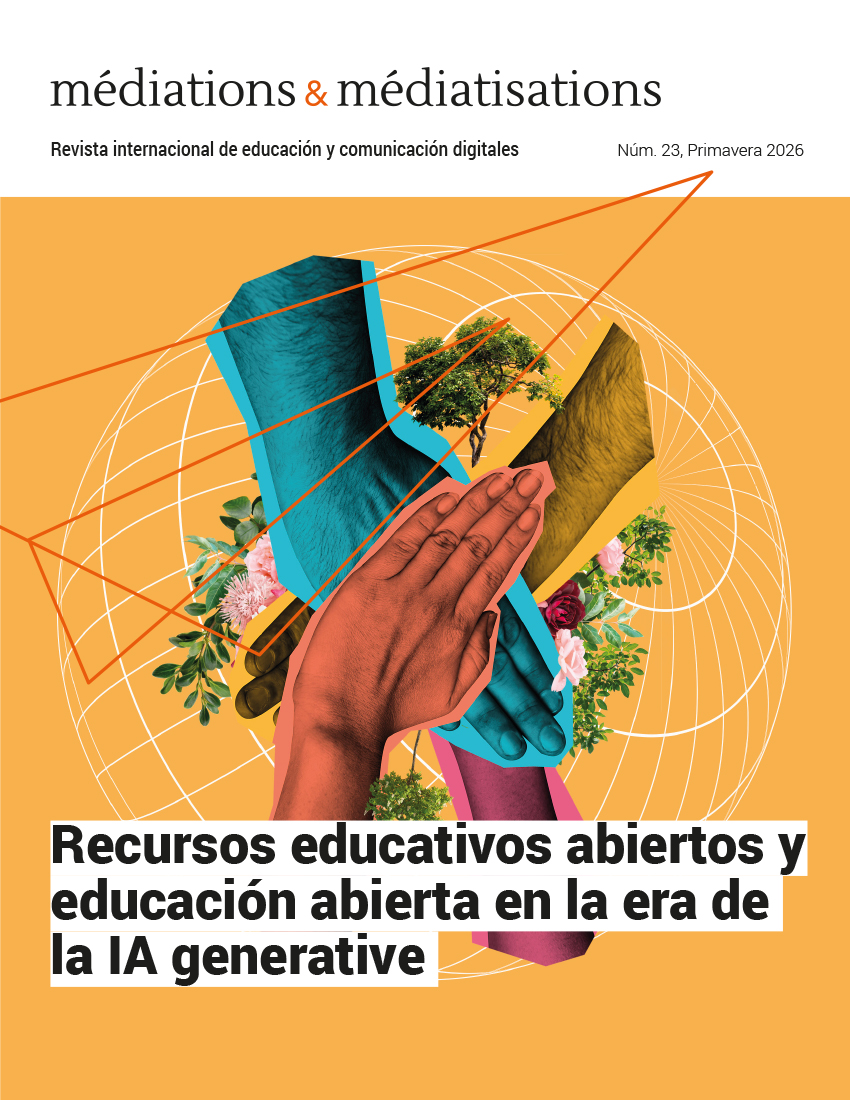
Contenido principal del artículo
Resumen
La reciente aparición de la inteligencia artificial generativa (IAG) en el ámbito de la educación ha influido en la transformación de las prácticas pedagógicas. La IAG ha abierto nuevas perspectivas para el diseño de recursos educativos digitales, interactivos, personalizados y adaptativos. Surgen preguntas sobre el potencial del uso de la IAG en la creación de recursos educativos abiertos (REA) basados en prácticas pedagógicas abiertas. Este artículo presenta una reflexión sobre la experiencia adquirida en el diseño de un REA modular dedicado al análisis y diseño de software, desarrollado con herramientas libres y distribuido bajo licencia Creative Commons CC-BY, sobre su uso, impacto, actualización y mejora. En él se describe la integración progresiva de la IAG en el proceso de producción y mejora pedagógica. Se han explorado varios usos: revisión lingüística y estilística, generación automática de cuestionarios, creación de tutores virtuales y experimentación con el modo «Estudiar y aprender» de ChatGPT-5. Las autoras presentan las ventajas de los usos experimentados, al tiempo que ponen de relieve las limitaciones tecnológicas, legales y éticas encontradas. Basándose en sus conclusiones, proponen recomendaciones a los creadores de REA sobre el uso de la IAG para la creación y la evolución de los REA.
Descargas
Detalles del artículo

Esta obra está bajo una licencia internacional Creative Commons Atribución-NoComercial-CompartirIgual 4.0.
Citas
Athaluri, S. A., Manthena, S. V., Kesapragada, V. K. M., Yarlagadda, V., Dave, T. et Duddumpudi, R. T. S. (2023). Exploring the boundaries of reality: investigating the phenomenon of artificial intelligence hallucination in scientific writing through ChatGPT references. Cureus, 15(4). https://doi.org/10.7759/cureus.37432 DOI: https://doi.org/10.7759/cureus.37432
Dedehayir, O. et Steinert, M. (2016). The hype cycle model: A review and future directions. Technological Forecasting and Social Change, 108, 28-41. https://doi.org/10.1016/j.techfore.2016.04.005 DOI: https://doi.org/10.1016/j.techfore.2016.04.005
DeepL (2025). DeepL Translator. https://www.deepl.com/translator.
Ding, T., Li, J., Shi, X., Li, X., et Chen, Y. (2023). Is artificial intelligence associated with carbon emissions reduction? Case of China. Resources Policy, 85(B). https://doi.org/10.1016/j.resourpol.2023.103892 DOI: https://doi.org/10.1016/j.resourpol.2023.103892
Francoeur, E., Yogarajah, A. et Rolo-Dussault, M. (2025). Voltaire: an AI Chatbot to Enhance Evidence-Based Argumentation on Technology and Society [communication]. SALTISE Conference.
Fuhrman, C. et Ross, Y. (2023). Analyse et conception de logiciels. École de technologie supérieure. fabriqueREL. https://doi.org/10.5281/zenodo.10520271
Gartner (2023, 16 août). Gartner Places Generative AI on the Peak of Inflated Expectations on the 2023 Hype Cycle for Emerging Technologies. https://www.gartner.com/en/newsroom/press-releases/2023-08-16-gartner-places-generative-ai-on-the-peak-of-inflated-expectations-on-the-2023-hype-cycle-for-emerging-technologies
Gartner (2025, 5 août). Gartner Hype Cycle Identifies Top AI Innovations in 2025. https://www.gartner.com/en/newsroom/press-releases/2025-08-05-gartner-hype-cycle-identifies-top-ai-innovations-in-2025
Gartner (s.d.). Gartner Hype Cycle. https://www.gartner.com/en/research/methodologies/gartner-hype-cycle
Germain, É., Guibault, F. et Radoev, N. (2024). Réorganisation de l’enseignement dans un cours introductif en analyse et conception de logiciels| Reorganization of Teaching in an Introductory Course in Software Analysis and Design. Proceedings of the Canadian Engineering Education Association (CEEA). https://doi.org/10.24908/pceea.2024.18581 DOI: https://doi.org/10.24908/pceea.2024.18581
Ministère de l’Industrie du Canada (2021). Consultation sur un cadre moderne du droit d’auteur pour l’intelligence artificielle et l’Internet des objets. https://www.ic.gc.ca/eic/site/693.nsf/fra/00316.html
Ministère de l’Éducation du Québec. (2025). L’utilisation pédagogique, éthique et légale de l’intelligence artificielle générative : guide destiné au personnel enseignant 2024-2025. https://cdn-contenu.quebec.ca/.
OpenAI (2025a). ChatGPT. https://chat.openai.com.
OpenAI (2025b). ChatGPT-4.1 via Copilot dans Visual Studio Code. https://chat.openai.com.
Peters, M. (2023). Utilisation transparente de l’intelligence artificielle / Acronyms and Icons for a Transparent Use of AI. https://mpeters.uqo.ca/logos-ia-fr-peters-2023/.
Sallam, M. (2023). ChatGPT utility in healthcare education, research, and practice: systematic review on the promising perspectives and valid concerns. Dans Healthcare, 11(6), 887. MDPI. https://doi.org/10.3390/healthcare11060887 DOI: https://doi.org/10.3390/healthcare11060887
UNESCO (2021). Recommandation sur l’éthique de l’intelligence artificielle. https://unesdoc.unesco.org/ark:/48223/pf0000381137_fre
Walters, W. H. et Wilder, E. I. (2023). Fabrication and errors in the bibliographic citations generated by ChatGPT. Scientific Reports, 13(1), 14045. https://doi.org/10.1038/s41598-023-41032-5 DOI: https://doi.org/10.1038/s41598-023-41032-5
Zewe, A. (2025, 17 janvier). Explained: Generative AI’s environmental impact. MIT News. https://news.mit.edu/2025/explained-generative-ai-environmental-impact-0117