
Discourse, plurilinguism and knowledge construction in MOOC and other forms of distance education
Article Sidebar
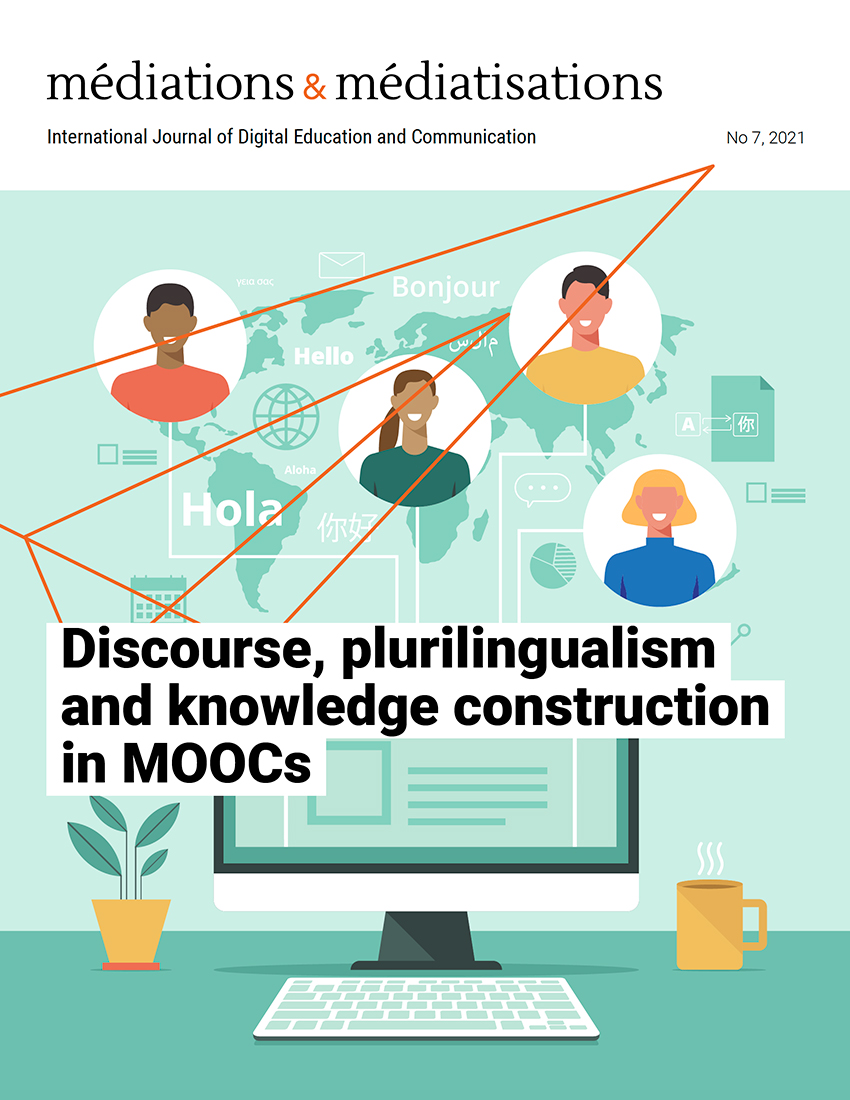
Main Article Content
Abstract
MOOC and other entirely or partially distance learning devices often use English and fairly standard media formats, notably due to accessibility concerns. However, the implications of the choices made in the design of these educational productions remain insufficiently explored. This editorial seeks to put into perspective the cross-cutting issues raised by these choices, while identifying their determinants and consequences. We argue for the need to develop interdisciplinary research on these distance learning devices mainly based on videos. To do so, we systematically question how linguistic, discursive and media components are articulated in institutional and technical structuring contexts. We conclude by presenting the contributions in this issue, which is devoted to the role of languages and discourses in the construction of knowledge in MOOC and other distance learning devices.
Downloads
Article Details
References
Altbach, P. (2014). MOOCs as neocolonialism: who controls knowledge? International Higher Education, 75, 5-7. https://doi.org/10.6017/ihe.2014.75.5426
Bayeck, R.Y. et Choi, J. (2018). The influence of National Culture on Educational Videos: The Case of MOOCs. International Review of Research in Open and Distributed Learning, 19(1), 186-201. https://doi.org/10.19173/irrodl.v19i1.2729
Berthoud, A.-C. et Gajo, L. (2020). The Multilingual Challenge for the Construction and Transmission of Scientific Knowledge. Amsterdam/Philadelphia : John Benjamins.
Bourgatte, M. et Jacobi, D. (2019). Les médiatisations visuelles des savoirs scientifiques. Dans B. Lafon (dir.), Médias et médiatisation (p. 241-271). Presses universitaires de Grenoble. https://doi.org/10.3917/pug.lafon.2019.01.0241
Bullich, V. (2018). La « plateformisation » de la formation. Distances et médiations des savoirs. Distance and Mediation of Knowledge, 2018(21), article 21. https://doi.org/10.4000/dms.2096
Campion, B., Peltier, C. et Peraya, D. (2019). Analyse communicationnelle de vidéos de MOOCs : quelle magistralité les choix discursifs construisent-ils? Éducation et formation, e-313. http://revueeducationformation.be/include/download.php?idRevue=33&idRes=354
Cassin, B. (dir.) (2004). Vocabulaire européen des philosophies. Dictionnaire des intraduisibles. Éditions du Seuil/Dictionnaires Le Robert.
Chevellard, Y. et Joshua, M.-A. (1991). La transposition didactique: du savoir savant au savoir enseigné. Grenoble : La Pensée sauvage.
Cisel, M. (2018). Les MOOC français à l’épreuve de la viabilité économique. Revue française des sciences de l’information et de la communication, 12. https://journals.openedition.org/rfsic/3355
Cisel, M., et Bruillard, E. (2012). Chronique des MOOC. Sciences et Technologies de l’Information et de la Communication pour l’Éducation et la Formation, 19(1), 49-73. https://doi.org/10.3406/stice.2012.1035
Cloutier, J. (1973). La communication audio-scripto-visuelle. Communication & langages, 19, 75-92. https://www.persee.fr/doc/colan_0336-1500_1973_num_19_1_4033
Coste, D. et Cavalli, M. (2020). Des traits constitutifs de toute médiation? Dans De Goia M. et Marcon M. (dir.). L’essentiel de la médiation. Le regard des sciences humaines et sociales (p. 261.288). Peter Lang.
Denis, M. (1989). Les images mentales. Paris : Presses universitaires de France.
Dillon, P., Wang, R. et Tearle, P. (2007). Cultural disconnection in virtual education. Pedagogy, Culture & Society, 15(2) 153-174. https://doi.org/10.1080/14681360701403565
Fauconnier, G. et Turner, M. (2002). The way we think. Conceptual blending and the mind’s hidden complexities. New York : Basic Books.
Fonseca, M. et Gajo, L. (2020). Le plurilinguisme dans les MOOCs : Profils d’usagers et fonctions du sous-titrage. Alsic. Apprentissage des Langues et Systèmes d’Information et de Communication, 23(2). https://doi.org/10.4000/alsic.4816
Fonseca, M. et Gajo, L. (2021). Le plurilinguisme dans les MOOCs : de nouvelles ressources pour la construction des savoirs. Bulletin suisse de linguistique appliquée, n° spécial, 2, 165-181.
Gajo, L. (2007). Linguistic Knowledge and Subject Knowledge: How Does Bilingualism Contribute to Subject Developement? The International Journal of Bilingual Education and Bilingualism, 10(5), 563-581. https://doi.org/10.2167/beb460.0
Jacquinot, G. (2012). Image et pédagogie. PUF. (Ouvrage original publié en 1977)
Jaillet, A. (2014). Les films promoteurs de MOOC, une rhétorique de la « divisio ». Distances et médiations des savoirs. Distance and Mediation of Knowledge, 2(8). https://doi.org/10.4000/dms.951
Kerr, R., Merciai, I. et Eradze, M. (2018). Addressing cultural and linguistic diversity in an online learning environment. Educational Media International, 55(4), 317-332. https://doi.org/10.1080/09523987.2018.1547546
Loizzo, J. et Ertmer, P. (2016). MOOCocracy: the learning culture of massive open online courses. Educational Technology Research and Development, 64(4), 1013-1032. https://doi.org/10.1007/s11423-016-9444-7
Meunier, J.-P. et Peraya, D. (2010). Introduction aux théories de la communication. Bruxelles : De Boeck. (Ouvrage original publié en 1993)
Moeglin, P. (1998). L’industrialisation de la formation. État de la question. Documents, actes et rapports pour l'éducation. Centre national de documentation pédagogique. https://hal.archives-ouvertes.fr/hal-01387355
Nkuyubwatsi, B. (2014). Cultural Translation in Massive Open Online Courses (MOOCs). eLearning Papers, 37, 1-10. https://www.academia.edu/23880005/Cultural_translation_in_MOOCspdf
Peltier, C. et Campion B. (2017). Regards pédagogique et communicationnel sur les capsules vidéo dans les MOOC. Distances et médiations des savoirs, 18. https://doi.org/10.4000/dms.1827
Peltier, C. et Campion, B. (2018). Constructions langagières, relation et cognition dans les capsules vidéo des MOOC. Pour une revisitation des possibilités éducatives de la vidéo. Distances et médiations des savoirs, 21. https://doi.org/10.4000/dms.2125
Phan, T. (2018). Instructional strategies that respond to global learners' needs in massive open online courses, Online learning, 22(2), 95-118. http://doi.org/10.24059/olj.v22i2.1160
Stratton, C. et Grace, R. (2016). Exploring Linguistic Diversity of MOOCs: Implications for International Development. Proceedings of the Association for Information Science and Technologie, 53(1). https://doi.org/10.1002/pra2.2016.14505301071
Young, J.R. (2012). The Object Formerly Known as the Textbook. The Chronicle of Higher Education, 27/01/2013. https://www.chronicle.com/article/the-object-formerly-known-as-the-textbook